


Uncategorized
What Is Penetration Testing and How Does It Work?
Aug
What Is Penetration Testing and How Does It Work?
An explainer on what penetration testing is and how it works end-to-end — build a threat model, define rules of engagement and test types, follow the engagement lifecycle, understand recon and enumeration mechanics, and see how vulnerabilities become safe, reportable proof on modern web, identity, cloud, and supply-chain targets.
If you’ve ever read a pentest report and wondered how the tester went from a domain name to “we can access sensitive data,” you’re not alone. The process can feel like a black box—especially when terms like “enumeration,” “pivoting,” and “exploit chain” get thrown around.
This explainer breaks the workflow into clear stages, from setting the threat model and rules of engagement to recon, validation, reporting, and retesting. You’ll also learn what’s different about testing today’s real-world surfaces: APIs, identity systems, cloud control planes, and supply-chain paths.
Threat Model Basics
Penetration testing is a controlled attempt to break your system the way an attacker would. The point is learning how your defenses behave under pressure, not collecting scan findings. Goals, scope, and rules of engagement set the boundaries of that pressure. Those choices shape what “realistic” means for your test.
Adversary Perspective
Attackers rarely win with one bug. They chain small weaknesses into a path that reaches something valuable.
A practical pen test mirrors intent and constraints:
- Intent: steal data, move money, disrupt service, or gain persistence.
- Constraints: time, access level, noise tolerance, and detection risk.
- Tradeoffs: stealth versus speed, breadth versus depth, safety versus realism.
That’s why a pen test is closer to “can I get in and what can I do” than “what is missing a patch.”
Key Terms Map
Threat modeling terms sound academic, but they drive every test decision.
- Scope: what systems are in bounds
- Asset: what you must protect
- Vulnerability: a weakness in design or config
- Exploit: a method that triggers weakness
- Risk: likelihood times impact
- Impact: business damage if exploited
- Likelihood: chance it gets exploited
If you can’t name the asset and impact, you can’t prioritize the path.
Rules Of Engagement
Rules of engagement turn “hacking” into safe, authorized testing. They protect your uptime, your customers, and your team.
Good rules usually cover:
- Written authorization and contacts
- Test windows and change freezes
- Outage safety checks and stop conditions
- Data handling, storage, and deletion
If the rules are vague, the test can succeed and still hurt you.
Testing Types
Different test types answer different exposure questions.
| Dimension | Option | Tester knows | Reveals |
|---|---|---|---|
| Knowledge | Black box | Minimal context | Outside-in exposure |
| Knowledge | Gray box | Some access | Realistic attacker path |
| Knowledge | White box | Full details | Control coverage gaps |
| Position | External vs internal | Internet vs inside | Perimeter vs lateral risk |
Pick the type that matches your decision, not your curiosity.
Engagement Lifecycle
Penetration testing works best as a controlled lifecycle, not a free-form hack. Each phase exists to reduce uncertainty, manage risk, and produce artifacts you can act on.
Subsections: [
{
“subheading”: “Recon And Enumeration”,
“content”: “You start by discovering what exists, because you cannot test what you cannot see. Hosts, services, identities, and trust paths define the real attack surface.\n\nGood enumeration produces concrete artifacts:\n- An asset and hostname list\n- Open ports and exposed services\n- Identity sources and role boundaries\n- Trust relationships between systems\n\nIf your inventory is incomplete, your test becomes a spotlight. The attacker works in the dark.”
},
{
“subheading”: “Vulnerability Analysis”,
“content”: “You turn raw observations into candidate weaknesses, because not every finding is exploitable. Context decides what matters, not the scanner’s severity label.\n\nAnalysts usually triage into pathways like these:\n- Reachability: can an attacker touch it?\n- Preconditions: credentials, network position, user action\n- Impact: data access, code execution, business disruption\n- Chaining: how it connects to other weaknesses\n\nScanner output is noise until it becomes a story. Your job is to find the shortest story to real impact.\n\n \n\n”
},
{
“subheading”: “Exploitation And Pivoting”,
“content”: “You prove whether a path works end-to-end, because theory is cheap. Then you test how far that access spreads through privileges and network trust.\n\n1. Exploit the initial weakness to gain a foothold.\n2. Enumerate privileges, tokens, and reachable internal services.\n3. Escalate privileges using misconfigurations or weak boundaries.\n4. Move laterally to adjacent systems via allowed trust.\n5. Repeat until a defined objective is met.\n\nSegmentation and IAM decide whether this is a hallway or a maze. Fix those, and most pivots die early.”
},
{
“subheading”: “Post-Exploitation Proof”,
“content”: “You capture evidence that the risk is real, because screenshots beat arguments. Evidence should be minimal-impact, so you avoid reading data you do not need.\n\nValid proof often includes:\n- Command output showing control\n- Access checks for sensitive actions\n- Minimal sample data, redacted\n- Logs showing authenticated access\n- Clear reproduction notes\n\nIf you need a database dump to prove impact, your validation method is the problem. Prove control, then stop.”
},
{
“subheading”: “Reporting And Retest”,
“content”: “You translate technical paths into business risk and fixes, because remediation teams do not ship “severity.” A good report includes the exploit chain, the root causes, and the specific control changes that break the chain.\n\nRetests verify fixes and catch regressions, using the same steps and artifacts as the original path. Without a retest, you have a document. With a retest, you have closure.\n\nIf a test uncovers active compromise or you suspect a real intruder, follow a structured incident-response checklist like <a href=”https://hacknexa.io/how-to-respond-to-a-black-hat-intrusion-9-steps”>what to do after a black hat intrusion before proceeding.\n\nFor more detail on what a strong pen test deliverable should include, see <a href=”https://hacknexa.io/what-is-vulnerability-management-and-how-does-it-work”>how vulnerability management works and PTES reporting guidance.”
}
]
Recon Under The Hood
Recon is discovery with constraints. You’re building a map from partial signals, and defenses decide how noisy that map becomes.
Discovery mixes public metadata, active probing, and careful inference. The trick is separating “not there” from “not visible.”
DNS And OSINT
Public metadata leaks structure because it has to support real operations. Subdomains, certificates, and code repos often expose naming patterns, third-party tools, and forgotten environments.
A typical OSINT pass pulls from places like these:
- DNS records: A/AAAA, CNAME, MX, TXT, SRV
- Certificate transparency logs: subdomains and SANs
- Public repos: config files, endpoints, API hosts
- Issue trackers and docs: internal URLs and screenshots
Treat every hit as a lead, not proof. Your next move is validation, not celebration.
Port Scanning Mechanics
Port scans infer state by observing responses and timeouts.
- Send a TCP SYN and watch for SYN-ACK, RST, or silence.
- Use TCP connect when raw SYN is blocked or needs privileges.
- Probe UDP and treat “no reply” as ambiguous, not closed.
- Adjust timing for rate limits, packet loss, and scan detection.
- Interpret results through NAT and filtering rules on each hop.
If defenses shape the answers, they also shape your confidence. Scan results are a hypothesis with error bars.
Fingerprinting Services
Fingerprinting identifies what’s behind an open port, not just that it’s open. Banners, protocol quirks, and TLS handshakes can reveal products, versions, and sometimes configurations.
Common signals include:
- HTTP headers and default pages
- SSH banner strings and key types
- SMTP greetings and extensions
- TLS certificate fields and supported ciphers
False positives happen when devices lie, proxies normalize responses, or services mimic others for compatibility. When it matters, confirm with multiple independent clues.
Enumeration Depth
Once you find an entry point, enumeration turns “a service exists” into “here’s how it behaves.” Go deeper where the blast radius is bigger.
- Endpoints and hidden routes
- Parameters and request bodies
- Shares, buckets, and drives
- Users, groups, and roles
- Cloud resources and policies
Depth is where most real findings live. Shallow recon finds doors; enumeration finds the keys.
Vulnerabilities To Exploits
A vulnerability is a flaw. An exploit is a working path through your real environment. The gap between them is where most risk gets misunderstood — and where structured validation and reporting (the kind platforms like Hacknexa.io typically support) can help teams separate “theoretical” from “actionable.”
Preconditions Matter
Two systems can share the same bug and have wildly different risk. Exploitability depends on where the attacker sits and what they can reach.
A few preconditions decide the outcome:
- Authentication state: anonymous, user, admin, or service account
- Network position: internet, VPN, internal segment, or same host
- Input reachability: can you hit the parameter at all
- Data shape: can you control length, type, and encoding
- Compensating controls: WAF rules, rate limits, sandboxing
Treat preconditions as part of the vulnerability, not footnotes — and capture them explicitly in your findings so triage reflects the real environment (many security workflows and reporting tools are built around making these preconditions unmissable).
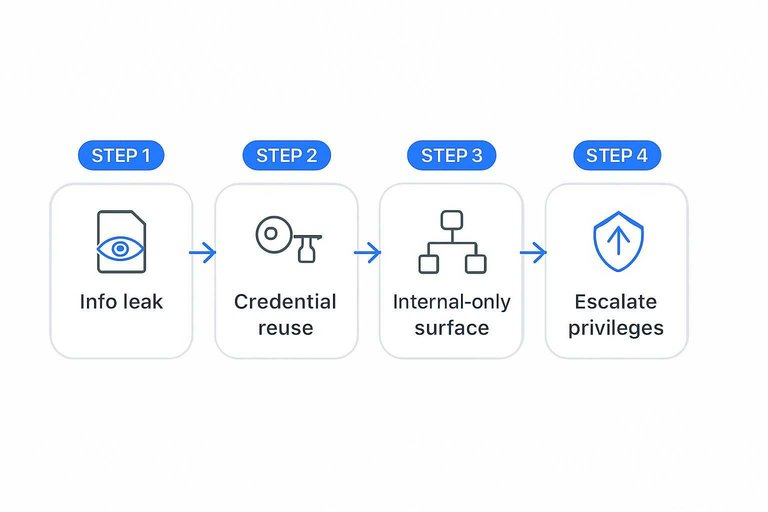
Exploit Chains
Single bugs rarely deliver the headline impact on their own. Attackers stack small weaknesses until the constraints disappear.
- Find an info leak that reveals usernames, paths, or tokens.
- Try credential reuse or weak reset flows on exposed accounts.
- Use the new access to reach an internal-only surface.
- Escalate privileges via misconfigurations or broken authorization.
- Pivot to data access or code execution where it matters.
Chaining is how “low severity” becomes “you’re owned.” Documenting the chain clearly — each step’s prerequisite, evidence, and resulting access — is often what turns a pile of “minor” tickets into a single, prioritized remediation plan (a good triage workflow makes this easier to track end-to-end).
Exploit Development Basics
Public exploits often fail because they target a different build, config, or runtime. A proof-of-concept usually assumes default paths, unpatched dependencies, and predictable memory layouts.
Exploit work becomes tuning:
- Payload: what you send and how it’s encoded
- Parameters: which inputs are actually controllable
- Environment: OS, library versions, mitigations, and permissions
- Timing: races, retries, and error handling
If it only works “in the lab,” it’s not an exploit yet. In practice, pairing PoC notes with environment details and reproducible steps (and exporting them in a consistent report format) reduces back-and-forth when defenders try to validate and fix.
Safe Validation Methods
You still need evidence, but you don’t need damage. Validate with proofs that show control without crossing the line.
- Run read-only queries that return known benign records
- Trigger harmless callbacks to a controlled listener you own
- Write a controlled file to a temp directory, then delete it
- Demonstrate access with metadata, not contents
- Use non-executing payloads that prove injection reachability
Good validation convinces defenders and keeps systems intact. It also makes remediation faster when the evidence is packaged cleanly (for example, as a standardized report with clear impact boundaries and guidance, as you’d expect from vulnerability management and reporting tooling like Hacknexa.io).
If you need a formal baseline for testing safety, coordination, and rules of engagement, reference NIST SP 800-115’s testing guidance.
Modern Target Surfaces
Pen tests used to orbit a single web server and a handful of pages. Now your attack surface is a mesh of apps, APIs, identities, and cloud control planes.
Web And API Logic
Most high-impact bugs now live in logic, not in templates or headers. Authorization gaps, odd state transitions, and business rules are where money moves.
Modern testing starts with a workflow map, not a sitemap.
- Model roles, permissions, and object ownership
- Trace state changes across API calls
- Try forbidden sequences and replays
- Abuse edge cases in totals and limits
If the API is the product, the workflow is the exploit.
Identity And IAM
SSO and federated login collapse many systems into one decision point. When token handling or OAuth settings are wrong, attackers ride your trust relationships.
Common identity attack paths in tests.
- OAuth redirect URI abuse
- Token audience and scope confusion
- MFA bypass via recovery flows
- Session fixation and weak rotation
Your perimeter is whoever can mint, steal, or reuse a token.
Cloud Control Planes
Cloud breaches often start as “just a misconfiguration” and end as privilege escalation. Testing focuses on policy edges, exposed data planes, and control-plane APIs.
- Enumerate storage, IAM roles, and public endpoints.
- Review policies for wildcard actions and unintended trust.
- Probe metadata services and instance credentials paths.
- Attempt lateral movement using assumed roles and tokens.
- Validate logs, alerts, and guardrails trigger on abuse.
If guardrails are quiet, attackers get time, and time is the real multiplier.
Supply Chain Entry
Your code runs other people’s code, and your pipeline runs with sharp permissions. Pen tests increasingly treat build and dependency paths as first-class entry points.
Common supply chain angles.
- Dependency confusion and typosquats
- Leaked keys in repos
- Over-permissioned CI runners
- Weak artifact repository access
- Compromised update channels
If your build can be influenced, your production can be owned.
Use This Mental Model to Evaluate (or Run) a Pentest
- Start with the threat model: who the adversary is, what matters most, and what testing type fits (black/gray/white box).
- Lock in rules of engagement: scope, time window, safety limits, data handling, and what counts as acceptable proof.
- Expect a lifecycle, not a single scan: recon/enumeration → analysis → controlled exploitation/pivoting → post-exploitation evidence → reporting and retest.
- Judge quality by clarity and safety: documented assumptions and preconditions, minimal-impact validation, and findings mapped to real business risk.
- Ensure modern coverage: web and API logic flaws, identity/IAM weaknesses, cloud control-plane misconfigurations, and supply-chain entry points.
Frequently Asked Questions
- What’s the difference between a penetration test and a vulnerability scan?
- A vulnerability scan mainly identifies known issues, while penetration testing validates real-world impact by attempting exploitation and chaining weaknesses to show how an attacker could reach sensitive data or systems.
- How do I choose the right type of penetration testing (web app, API, cloud, internal, or mobile)?
- Choose based on where your critical data and authentication paths live: web/API for customer-facing logic, cloud for misconfigurations and IAM, internal for lateral movement risk, and mobile when the app handles auth tokens, secrets, or sensitive data flows.
- How do I prepare for a penetration test so it doesn’t disrupt production?
- Provide a clear test window, dedicated test accounts, IP allowlisting (if needed), and a point of contact for incident response so findings don’t get mistaken for a real attack and testers can pause if instability appears.
- What should a good penetration testing report include for developers and executives?
- It should include reproducible steps and evidence, affected assets, risk-ranked findings with business impact, and specific remediation guidance plus retest criteria so teams can verify fixes.
- Can I manage penetration testing findings and remediation in one workflow?
- Yes—use a system that tracks findings from discovery to fix with owners, status, evidence, and exportable reporting; if you need an integrated intake-and-triage workflow, a platform like Hacknexa.io may fit, assuming it supports your target surfaces and reporting needs.
Operationalize Your Pen Tests
Understanding threat models, recon, and exploit paths is useful—but turning those steps into a repeatable engagement lifecycle across modern target surfaces takes real operational bandwidth.
Hacknexa.io helps you run web/API penetration testing and vulnerability assessment with streamlined disclosure intake, triage workflows, and exportable reports to speed remediation.
Sources
Written with Skribra
