


Uncategorized
What Are Cybersecurity Services and How Do They Work?
Aug
What Are Cybersecurity Services and How Do They Work?
An explainer on what cybersecurity services are and how they operate in practice—service vs. product distinctions, threat surfaces and attack lifecycles, foundational prevention programs, detection/monitoring with SIEM/XDR, and incident response and recovery workflows.
If you’ve ever shopped for “cybersecurity,” you’ve probably hit a wall: dozens of tools, endless acronyms, and vendors promising to solve everything. The hard part isn’t buying technology—it’s understanding what work actually has to happen, day to day, to reduce risk.
This explainer breaks cybersecurity services into clear categories and shows how they map to real threats. You’ll learn the mental model behind prevention, monitoring, and incident response, what each service typically includes, and how these pieces fit together when something goes wrong.
Service vs Product
Cybersecurity services are ongoing operational work, not a one-time tool purchase. You’re paying for people, process, and accountability that keep security running day after day.
Tools still matter, but services decide if those tools are configured, watched, and improved. That’s how services map to the attack lifecycle, not just the shopping list.
What counts as service
A service is work delivered over time, usually with a defined scope and a cadence. The goal is steady protection, not a box on a network diagram.
Cybersecurity services typically include:
- Consulting and security program design
- Continuous monitoring and alert triage
- Incident response and forensics support
- Managed delivery models like MSSP and MDR
If nobody is operating it, tuning it, and answering at 2 a.m., it’s not a service.
Why services exist
Tools alone fail because security drifts. Threats change, settings degrade, and “temporary” exceptions become permanent.
A common example is an alerting tool that floods your team. Without tuning and triage, people start ignoring it.
Services exist to keep the system honest, even when your priorities shift.
Core service categories
Most cybersecurity services fall into a few operational buckets. Knowing the bucket helps you buy the right motion.
- Governance, risk, and compliance (GRC)
- Security operations (SOC, monitoring)
- Identity and access management (IAM)
- Cloud security operations
- Application security (AppSec)
The real question is coverage gaps, not category names.
Mental model preview
You can frame most services as repeatable workflows across four phases. Simple beats clever when you need consistency.
Prevent, detect, respond, recover. Each phase becomes a set of routines with owners, playbooks, and metrics.
If you can’t point to the workflow, you’re buying activity, not capability.
Threats and Surfaces
Cybersecurity services defend what you run and what you store, not an abstract “environment.” They also defend against behaviors: how attackers probe, enter, expand access, and monetize it.
That framing drives service design. You prioritize what matters most, then cover the paths that reach it.
Assets to protect
You secure different targets in different ways, because failure modes differ. Treat them as distinct asset classes.
- Data: files, records, backups
- Identities: users, roles, keys
- Endpoints: laptops, servers, mobile
- Networks: segments, DNS, traffic
- Applications: code, APIs, dependencies
- Cloud resources: accounts, storage, workloads
If you can’t name the asset, you can’t set the control.
Attack lifecycle basics
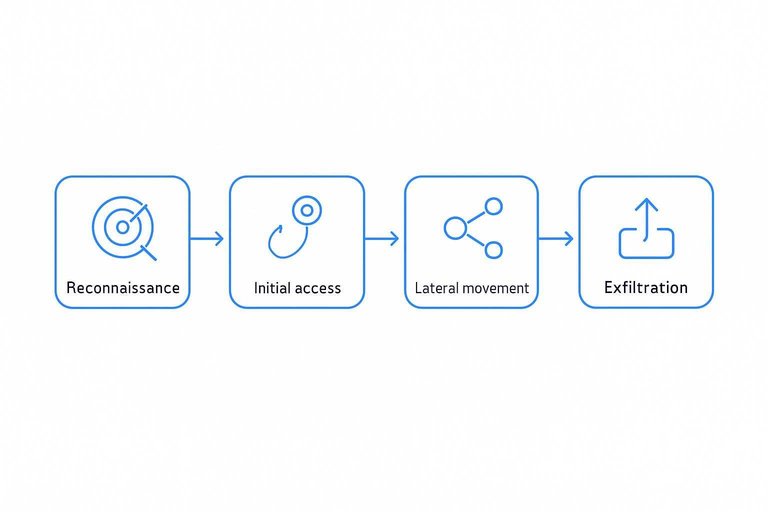
Most attacks follow a repeatable sequence, even when tools and targets change.
- Reconnaissance: map people, systems, and exposed services.
- Initial access: exploit, phish, or steal credentials.
- Execution: run code or commands on a foothold.
- Persistence: keep access after reboots and resets.
- Privilege escalation: obtain higher permissions.
- Lateral movement: reach other systems and accounts.
- Exfiltration: copy data out quietly.
- Impact: encrypt, destroy, extort, or disrupt.
If you can spot the stage, you can pick the right lever.
For a canonical breakdown of these stages, see MITRE ATT&CK Enterprise tactics.
Why breaches happen
Breaches usually come from gaps that compound, not one dramatic failure. Visibility gaps hide early signals, configuration drift reopens old holes, and weak identity controls turn one credential into many.
Slow patching leaves known exposures live, and unpracticed response turns minutes into days. Attackers win when your basics don’t connect.
Service mapping logic
Good service design maps controls to lifecycle stages and to the assets you care about. Hardening and preventive controls aim to stop initial access and execution, while monitoring and response focus on fast detection and containment.
You trade prevention depth against detection speed and cost. Choose based on what you can’t afford to lose, then instrument the rest.
Foundational Prevention
Cybersecurity services reduce compromises by removing easy wins for attackers. You harden systems, patch quickly, segment networks, and standardize configurations so fewer things can go wrong.
Risk-based hardening
Hardening services turn “best effort” security into repeatable baselines. The goal is fewer unsafe defaults and fewer one-off exceptions.
Teams usually start with benchmark-style guidance, like CIS-style controls, then tailor it to your risk and operations:
- Define a baseline per asset type: laptops, servers, cloud accounts, network devices.
- Map settings to intent: restrict admin rights, disable legacy protocols, enforce MFA.
- Document exceptions with an owner and expiry date.
- Validate with automated checks and periodic sampling.
Standardization is what makes audits faster and mistakes rarer, because everyone is grading the same rubric.
Vulnerability management loop
Vulnerability management is a loop, not a report. The point is reducing exploitable exposure, not collecting CVEs. For a deeper breakdown, see how vulnerability management works.
- Scan assets on a schedule and after major changes.
- Validate findings to remove false positives and duplicates.
- Prioritize by exploitability, exposure, and business impact.
- Remediate with patches, mitigations, or compensating controls.
- Retest to confirm closure and prevent reopenings.
Prioritization beats raw counting because one reachable, exploitable flaw matters more than fifty theoretical ones.
Configuration drift control
Configuration drift control catches changes that quietly undo your baselines. It matters most in cloud and endpoints, where changes happen daily.
Services typically use continuous checks to compare current state to an approved configuration:
- Monitor critical settings: IAM, logging, storage access, endpoint policies.
- Alert on deviation, then route tickets to the owning team.
- Auto-remediate safe items, like toggling a known setting back.
- Track trends so recurring drift becomes a process fix.
Drift is inevitable because people ship fixes, tools update, and environments scale, so you need detection built-in.
Preventive controls examples
Most prevention work ships as concrete deliverables you can point to. You should be able to operationalize each one.
- Patch SLAs by system tier
- Firewall rules review cadence
- Device encryption enforcement
- EDR policy tuning
- Secure email filtering rules
When these are owned and measured, prevention stops being a project and becomes the default state.
Detection and Monitoring
Detection and monitoring services turn scattered activity into a single, readable picture. They collect telemetry, correlate signals, and run triage workflows that separate harmless weirdness from real attacker behavior. In practice, teams get the best results when monitoring is paired with a clear view of what should be fixed first—outputs from vulnerability assessment and penetration testing can sharpen what you alert on and how you prioritize response.
This aligns well with the NIST Cybersecurity Framework’s Detect function, which emphasizes continuous detection outcomes alongside protection and response.
Telemetry sources
Visibility starts with wide, consistent telemetry. You want signals that show who did what, where, and with which device.
- Endpoint process and EDR events
- Identity provider sign-ins and MFA logs
- Network flows, firewall, and proxy logs
- SaaS admin actions and sharing events
- Cloud audit logs and control plane events
If three sources disagree, treat that gap as the incident.
It also helps to align telemetry to known exposures: findings from a scanner or web/API testing (the kind of workflow a platform like Hacknexa.io likely supports) can tell you which apps, endpoints, and identities deserve higher-fidelity logging and tighter retention.
SIEM and XDR internals
SIEM and XDR platforms take messy events and make them comparable. They normalize fields, enrich with context, correlate related activity, and route alerts to the right queue.
Detections need constant tuning because your environment keeps changing. New apps, new users, and new attacker tricks never stop.
A practical way to keep tuning grounded is to feed in security testing outputs—vulnerability assessments, penetration test observations, and remediation status—so correlation rules reflect what’s actually exploitable today, not just what’s theoretically risky.

Triage workflow
Triage is the assembly line that turns alerts into decisions. It keeps you fast under pressure.
- Ingest alerts, assign an owner, and timestamp the intake.
- Deduplicate similar alerts and group by entity and time window.
- Score severity using asset value, identity risk, and blast radius.
- Investigate with pivoting across logs, timelines, and related entities.
- Escalate when impact is plausible, then document actions and evidence.
Your workflow is your real detection product, not the dashboard.
Teams often speed this up by standardizing the “evidence + fix” handoff: if you can attach relevant vuln context (affected endpoint/app, proof, remediation guidance, and current status) from the same place you track testing and triage—such as a vulnerability intake and reporting workflow—alert decisions become more consistent.
Reducing false positives
False positives drop when alerts carry more context. Enrichment, baselines, and feedback loops help you label normal behavior before you page someone.
Noise rises as you add coverage because you see more edge cases. Treat tuning like maintenance, not a one-time setup.
One reliable source of context is your own security validation work: when a finding is confirmed via web/API testing or a scan, you can bias detections toward higher-signal patterns around those assets, and de-prioritize “generic” alerts elsewhere until they’re tied to a real exposure and tracked through remediation.
Response and Recovery
Incident response and recovery services exist to stop the bleeding fast, then get you safely back to business. They focus on four outcomes: contain damage, remove attacker access, restore operations, and harden defenses using what you learned.
IR readiness pieces
Preparation turns chaos into a checklist. You win time because you already know who acts, where evidence lives, and what “good” looks like.
- Incident playbooks for common scenarios
- Escalation contacts and on-call paths
- Emergency access to key systems
- Evidence handling and retention rules
- Tabletop exercises and after-action notes
When the alert hits at 2 a.m., your prep becomes your speed.
Containment mechanics
Containment services aim to cut attacker control without destroying evidence. The goal is to stop spread while keeping enough visibility to understand scope.
Teams typically isolate affected hosts, reset or revoke compromised credentials, and block known indicators like malicious domains and hashes. They also disable risky OAuth apps, revoke tokens, and tighten network paths using segmentation or temporary firewall rules.
Containment is a tradeoff. Move fast, but don’t blind yourself.
Forensics essentials
Forensics answers two questions: what happened, and how do you prove it. You need both to fix the problem and to defend decisions later.
Responders preserve logs early, then build timelines across identity, endpoint, and network events. They collect memory and disk artifacts to catch fileless malware, persistence, and lateral movement, then run root-cause analysis to find the initial access and missed controls.
Chain-of-custody isn’t paperwork theater. It’s what keeps evidence trustworthy under pressure.
Recovery steps
Recovery is a controlled return to service, not a mad dash to “green.”
- Restore known-good data from backups.
- Rebuild or reimage affected systems.
- Validate integrity and configuration baselines.
- Monitor aggressively for reinfection signals.
- Communicate status and risk to stakeholders.
If you restore first and verify later, you may just restore the attacker too.
Authorized scope and evidence boundaries
Incident response work only holds up if it stays inside clear legal and operational guardrails. Before anyone “touches” a system, confirm who is authorizing the engagement, which assets are in scope (including cloud tenants, SaaS orgs, endpoints, and third-party providers), and what actions are allowed (e.g., account resets, mailbox access, endpoint isolation, malware detonation, data restoration). If authorization is unclear, pause and get it in writing—doing the right technical move with the wrong permission can create a second incident.
Evidence handling has similar boundary conditions. Treat potentially relevant artifacts (logs, disk images, memory captures, email exports, chat transcripts, cloud audit trails) as evidence from the start: preserve originals, record who collected what and when, and keep working copies separate. Avoid “cleanup” steps that overwrite history—reimaging, log rotation changes, uninstalling tooling, or mass password resets—until you’ve captured what you need to support root-cause analysis and any regulatory, insurance, HR, or legal follow-up.
When the situation may involve fraud, insider activity, or law enforcement interest, align early on a triage path: who can approve deeper collection, where evidence is stored, how long it’s retained, and who can access it. The goal isn’t red tape—it’s making sure your response actions are defensible and your evidence remains usable under scrutiny.
Use This Mental Model to Choose the Right Services
- Start with your assets and exposure: list what must stay protected (identity, endpoints, cloud, data) and where attacks are most likely to enter.
- Build prevention first: prioritize risk-based hardening, a vulnerability management loop, and configuration drift controls so you reduce the number of incidents you create.
- Add detection you can operationalize: confirm telemetry coverage, define triage ownership, and tune alerts so your team can act without drowning in noise.
- Plan for failure: document IR roles, containment playbooks, forensics requirements, and recovery steps so response is fast, coordinated, and repeatable.
Frequently Asked Questions
- What are managed cybersecurity services (MSSP), and how are they different from a one-time security assessment?
- Managed cybersecurity services provide ongoing monitoring and operational support (often 24/7), while a one-time assessment is a point-in-time review that identifies issues but doesn’t continuously detect or respond to new threats.
- Do small businesses really need cybersecurity services, or are security tools enough?
- Small businesses usually need at least a baseline service layer (patching, monitoring, and incident response readiness) because tools still require configuration, alert triage, and follow-through to reduce real risk.
- How do I measure whether cybersecurity services are working?
- Track operational metrics like patch compliance, mean time to detect (MTTD) and respond (MTTR), alert volumes by severity, and the closure rate of remediation tickets tied to verified findings.
- What cybersecurity services do I need for cloud environments like AWS, Azure, or Google Cloud?
- You typically need cloud posture management (misconfiguration and identity controls), workload and container monitoring, centralized logging/SIEM integration, and cloud-focused incident response playbooks.
- Can I use penetration testing instead of ongoing cybersecurity services?
- Penetration testing complements ongoing cybersecurity services by finding exploitable weaknesses at a point in time, but it doesn’t replace continuous monitoring and response; if you need structured vuln testing workflows and remediation reporting, a platform like Hacknexa.io may fit that specific testing-and-triage slice.
Operationalize Your Security Program
Understanding prevention, monitoring, and response is step one; keeping coverage consistent across changing threats and attack surfaces is the real challenge.
Hacknexa.io helps you turn that framework into action with vulnerability assessments, web/API penetration testing, and workflow-driven reporting that accelerates remediation.
Sources
- MITRE ATT&CK — Enterprise Tactics (Initial Access, Execution, Persistence, Privilege Escalation, Lateral Movement, Exfiltration, Impact, etc.) — referenced in Attack lifecycle basics
- NIST Cybersecurity Framework (CSF) 1.1 — The Five Core Functions (Identify, Protect, Detect, Respond, Recover) — referenced in Detection and Monitoring
Written with Skribra
