


Uncategorized
Vulnerability Disclosure Management Platforms in 2026: Buyer’s Guide
Sep
Vulnerability Disclosure Management Platforms in 2026: Buyer’s Guide
2026 buyer’s guide to vulnerability disclosure management platforms: minimum VDP workflow, disclosure rules, triage caps, and a scenario-based shortlist.
You need a clean way for outsiders to tell you about security flaws in your systems. The obvious approach—publishing an email address or form—turns into duplicates, vague reports, and unclear expectations about what happens next. If you mishandle it, you either miss a real vulnerability or inherit a never-ending confidentiality obligation that’s hard to justify to leadership and compliance.
This guide gives you the minimum workflow from intake to coordinated disclosure, the policy decisions that determine who can disclose and when, what to require to keep triage noise and SLAs manageable, and the integration/audit checks to run before you sign—then a 2026 shortlist mapped to common scenarios.
Minimum viable VDP: the smallest workflow that still counts
A VDP (Vulnerability Disclosure Program) is a public policy plus a workflow for receiving and handling vulnerability reports—often without paying bounties. “Minimum viable” matters because the failure mode is predictable: you publish an email address, reports arrive, and you end up with an inbox full of permanently confidential findings and no defensible record of what you did about them.
VDP management starts the moment you do two things consistently:
- treat every report as a trackable case (not an email thread), and
- keep a clear path from “received” to “closed” that includes a disclosure decision.
That can be done with a dedicated platform, a general workflow tool, or a provider’s portal (if it supports public intake). The platform choice comes later; the workflow is the part you can’t skip.
Intake to disclosure
CVD (Coordinated Vulnerability Disclosure) is the practice of handling a report privately while a fix is prepared, then disclosing on a coordinated timeline. The minimum viable VDP workflow is the shortest path that still makes that possible.
-
Intake (public, reachable, structured)
Give researchers one obvious place to submit, and collect the fields you need to reproduce the issue (asset, steps, impact, proof). -
Acknowledge (close the “did you get it?” loop)
Confirm receipt and give a case/reference the reporter can use. If your process can’t acknowledge reliably, you don’t have a program—just a mailbox. -
Validate / triage
Triage (validation) is the step where reports are reproduced, de-duplicated, and severity-scored before engineering work starts. This is where you decide whether it’s real, whether it’s already known, and whether it’s in scope. -
Remediation tracking (turn a report into engineering work)
Record who owns the fix, what “done” means, and the current status. The minimum bar is a timeline you can defend later: when you confirmed, when you notified engineering, and when you verified the fix. -
Disclosure decision (explicit, not implied)
Decide whether and when details can be shared publicly. Many programs make this concrete via an NDA (a confidentiality agreement) window—for example, Bugcrowd’s VDP Compliance plan includes a 90-day NDA. Other disclosure regimes define a deadline-based “last resort” path: HackerOne’s guidelines state that if a security team does not respond to a formal disclosure request for 180 days (with follow-ups at least once every 30 days), a community member may publicly disclose unless the program’s policy prohibits it, and CERT/CC’s policy states it will disclose vulnerabilities publicly 45 days after the initial report.
If you don’t explicitly choose and document your disclosure rule, you’ll discover later that you chose it accidentally—by defaulting to silence.
Not a bug bounty
A VDP can be “no rewards,” and it still needs management. A bug bounty adds marketplace mechanics that change the operating model.
What changes when you add bounty mechanics:
- Incentives and payments become part of workflow. You need a payout decision, payment handling, and fraud/abuse handling. VDP management does not require any of that.
- Triage load becomes a product feature, not just an ops problem. Some offerings explicitly package triage capacity—for example, Bugcrowd’s VDP Basic plan includes “Managed Triage for First 15 Submissions.” That’s a marketplace-style lever, even when the program is positioned as VDP.
- Researcher access and rules get more formal. Marketplace programs often include account mechanics, limits, and researcher-side controls; for example, HackerOne documents a “Platform Limit” where new hackers may be capped at 6 trial reports.
- Scope pressure goes up. Bounty-style programs attract optimization: researchers chase the best ROI, and your scope boundaries get tested hard.
If you want public intake and a clean audit trail but you don’t want to run rewards, you’re shopping for VDP management—not a bounty marketplace.
Not a pentest portal
A pentest portal is built for a time-boxed, paid engagement with an agreed scope and a defined deliverable. VDP management is built for continuous, external inbound reporting.
Key differences:
- Who can report: VDP assumes unknown, external reporters can show up at any time; pentests assume named testers on a contract.
- What “done” means: VDP closes when you’ve validated, remediated, and made a disclosure decision; pentests close when the report is delivered (fixing may be out of scope).
- Timeline shape: VDP is an ongoing queue; pentests have a start/end date.
- Disclosure expectations: VDP must say what the reporter can share and when; pentest findings are usually confidential by default and routed through the buyer.
- Communication model: VDP needs a two-way conversation thread with an external party; pentest portals can treat the tester like an internal project resource.
If your real need is “a place for our hired testers to upload findings,” buy a pentest workflow. If your real need is “anyone on the internet can report issues and we must handle them predictably,” you need VDP management.
Disclosure model first
The platform you pick isn’t just an intake form and a queue. It quietly chooses your disclosure model—who’s allowed to publish details, when they’re allowed to, and what happens when remediation stalls.
That matters because “coordinated disclosure” only works if time moves forward. If your rules require permission at every step, you can end up with reports that are permanently confidential by default.
Two terms you’ll see in platform policies:
- Safe harbor — policy language promising good-faith researchers won’t face legal action when they follow the rules.
- NDA — a confidentiality agreement that can restrict what a reporter can share publicly and when.
Below are the common disclosure shapes platforms encode, and the traps they create.
Permission-gated disclosure
Permission-gated disclosure means nothing goes public unless someone explicitly approves it. On paper, that sounds “safe.” Operationally, it creates a veto.
Intigriti’s public-disclosure guidance is a clean example of how this works. It states that disclosing to anyone other than Intigriti and the company requires approval from both Intigriti and the company. It also states Intigriti doesn’t offer a disclosure feature inside the platform, and that disclosure requests should be made via a comment in the report thread.
That combination (approval required + request lives inside a ticket comment) creates a very specific buyer risk:
- Disclosure becomes a workflow negotiation, not a clock. If one side stops engaging, there’s no built-in timer that forces a decision.
- Your “process” is only as responsive as the slowest approver. If the program owner goes dark, the policy still says “permission required.”
- The platform can be excellent at case management while still enabling indefinite confidentiality. The UI will show “open,” “pending,” “needs response”—but the policy outcome stays frozen.
If you’re buying a platform to run time-bounded CVD, permission-gating is fine only when it’s paired with an explicit last-resort path that can’t be vetoed by silence.
Platform last resort
A last-resort path is the clause that answers one question: what can a reporter do if you stop responding?
Without that clause, “coordinated disclosure” can degrade into “coordinated non-disclosure,” where the only stable state is quiet.
The hard part is that the industry does not converge on one number or one norm. Published expectations range from shorter advisory timelines (Rapid7 describes a typical ~60-day advisory publication timeline, with possible extensions) to longer default windows (ZDI describes a standard 120-day timeline). The takeaway isn’t that one is right. It’s that your platform and your policy must make your choice explicit.
When you evaluate a platform’s disclosure model, you’re looking for three structural features:
- Who can invoke last resort. The original reporter only? Any community member? A mediator?
- What “non-responsive” means. Is it “no message at all,” or “no substantive progress,” or “no decision on a disclosure request?”
- Whether your own policy can forbid last resort entirely. Some programs allow disclosure only if the program’s policy permits it; others set a deadline regardless.
If the last-resort path exists only as “ask in a comment” and the answer can be “no” forever, you’re back to permission-gating with nicer UX.
Hard disclosure deadlines
Hard-deadline disclosure flips the default. Instead of “private until approved,” it’s “private until the deadline.”
This model is blunt, and that’s the point: it prevents indefinite suppression when remediation drags.
You’ll see hard timelines described by major disclosure practitioners, even though they disagree on duration. Rapid7 documents a typical ~60-day path (with extensions), while Trend Micro’s Zero Day Initiative (ZDI) describes a standard 120-day timeline.
What to notice as a buyer isn’t just the day count. It’s what the deadline is anchored to:
- Initial report date. The simplest anchor. It prevents a program from resetting the clock by “re-triaging.”
- Reproduction/validation date. More fair to the vendor, but easier to stall if validation is slow.
- A formal disclosure request. Cleanly separates “I reported” from “I’m ready to publish,” but requires a defined request mechanism.
A platform can support deadline-based disclosure even if it doesn’t have a “publish advisory” button. But it must support the underlying governance: timestamps, explicit states, and a way to record disclosure decisions that can’t be quietly rewritten later.
NDA defaults matter
NDAs are not just legal text. In practice, they’re a disclosure timeline.
Here’s the failure mode: a platform’s default workflow treats every report as confidential “until resolved,” then adds an NDA or confidentiality clause on top. If the NDA window is undefined, extendable without limits, or triggered by vague milestones (“until fixed”), you’ve created a confidentiality trap that a busy team will fall into by doing nothing.
Practitioners disagree on whether NDA-heavy terms belong in VDP workflows at all. One side treats confidentiality as normal and necessary to reduce legal and exploitation risk. The other side argues that NDA-heavy terms can chill reporting and enable indefinite suppression, and prefers explicit, time-bounded disclosure policies.
Your job as a buyer isn’t to pick a philosophical camp. It’s to make sure the platform doesn’t silently pick one for you.
Two concrete checks:
- Is confidentiality the default state, or a negotiated state? If every ticket is “confidential forever unless approved,” you need a deadline elsewhere.
- Can the NDA be used as a substitute for a disclosure policy? If “sign this NDA” is the only disclosure rule you can point to, you don’t have a time-bounded coordinated-disclosure program.
If you work with a managed provider (including platforms that bundle triage/program operations) or you’re evaluating an integrated workflow tool such as Hacknexa.io, ask them to show you exactly where the disclosure clock lives: in policy text, in platform states, and in who is authorized to make the call.
Policy clauses to require
Your platform demo should end with the policy text on screen. If the vendor can’t map these clauses to product behavior, you’re buying a UI—not a disclosure model.
- Safe-harbor language is explicit. It should clearly cover good-faith testing and reporting within scope.
- Who can request disclosure is defined. Reporter, program owner, both, or a mediator.
- Approval steps are concrete. “Approval required” is not enough; specify whose approval, and how it’s recorded.
- A last-resort path exists. Define what “non-responsive” means and what action becomes permitted.
- The timeline anchor is unambiguous. Initial report date, validation date, or formal disclosure request—pick one.
- Confidentiality/NDA terms can’t run forever by default. If there’s an NDA, it needs a bounded window or a hard decision point.
If you can’t point to the clause that forces a disclosure decision when remediation stalls, you’re structurally set up for indefinite confidentiality—no matter how good the workflow looks.
Triage and noise
Triage is where VDPs either become a reliable pipeline or a permanent backlog. The practical question isn’t “can we receive reports?” It’s “what volume of triage work are we contractually signing up for, and what happens when we exceed it?”
Two terms to ground the rest:
- CVSS — a scoring system used to rate severity/impact of a vulnerability.
- SLA — a defined response/remediation time target, often tiered by severity.
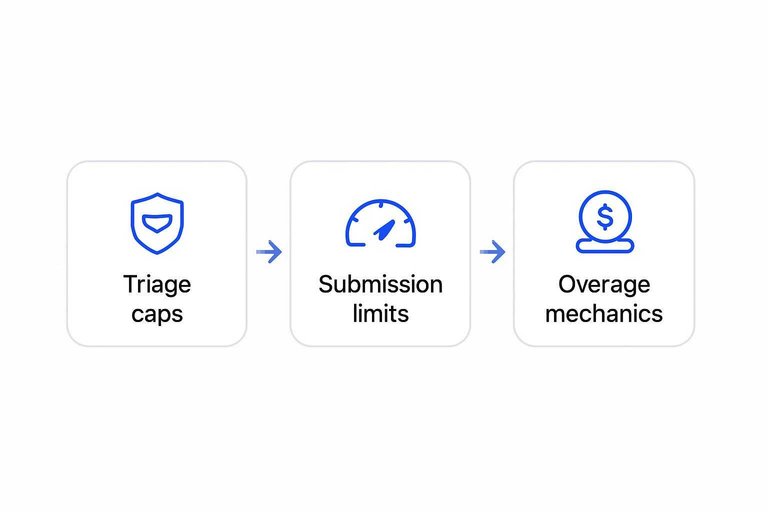
If your intake is open to the public, “noise” is just another word for unpaid triage labor: duplicates, out-of-scope issues, low-quality writeups, and reports that are real but not actionable. Platforms manage that labor with three levers, and each one maps directly to staffing load and SLA risk.
1) Managed triage caps (someone else does the first wave — until the cap ends)
A managed triage bundle is a staffing plan disguised as a product feature. For example, Bugcrowd’s VDP BASIC is sold with a specific included allowance: managed triage for 75 submissions. Bugcrowd also lists VDP BASIC pricing at $299/month and $999/month (two Basic options are shown), which is useful because it forces you to treat triage as a line item rather than an “inbox problem.”
The operational translation is simple: once you burn through the included managed triage submissions, you either absorb the work internally or you pay for whatever “more” looks like in that vendor’s contract.
That’s the SLA landmine. Your external SLA (time-to-acknowledge, time-to-triage, time-to-initial-decision) can be perfectly designed on paper, but it collapses the moment the queue shifts from “vendor does first-pass validation” to “your team does first-pass validation.” If you want an SLA that survives a spike, you need the vendor to tell you—before you sign—what happens after the included triage allotment.
2) Submission limits (rate limiting by policy or by plan)
Some platforms constrain volume up front—either at the researcher level or at the program level.
One researcher-side example: HackerOne documents a platform limit of 6 trial reports for new hackers. That is a noise-control mechanism. It doesn’t eliminate garbage reports, but it does cap how much of your triage capacity can be consumed by brand-new accounts in a short window.
Plan-level limits are even more staffing-relevant because they define your annual load in writing. Synack’s Managed Vulnerability Disclosure Program is explicit: it includes 200 vulnerability submissions per year. That number is not just a commercial term—it’s an upper bound you can plan against when you design coverage, rotations, and escalation paths.
3) Overage mechanics (what “more” means when you exceed the limit)
“Overage” is where programs quietly fail.
Synack spells out the shape of overage: each additional submission after the annual limit is 1 credit. The key detail is the unit. Your backlog risk is no longer just “more tickets”; it’s “more tickets that trigger a different commercial meter.”
That changes behavior in predictable ways:
- Security teams start triaging with one eye on the queue and one eye on the credit burn.
- SLAs become financially coupled to volume, not just severity.
- The program owner gets put in the position of deciding whether to spend credits on borderline reports—or accept SLA breaches/backlog growth.
You don’t need the credit price to see the governance problem. If “1 extra submission = 1 credit,” then you need contractual clarity on who approves credit spend, how fast credits can be added, and whether credits apply to all submissions or only “valid” ones.
Where this gets real: choosing an SLA you can actually keep
Your SLA should be written in the same language your triage limits use.
If your contract is defined in submissions per month or submissions per year, then your operational SLA needs an explicit “surge” plan that answers: what happens when the platform intake stays open but your included triage capacity is exhausted?
Lightweight plans make the constraint obvious. OpenHunt lists a Free plan at $0/month with 5 included reports per month, and a Pro plan at $79/month. Those numbers won’t fit every organization, but they demonstrate the real planning move: a “report cap” is functionally a staffing cap.
If you can’t staff triage internally, you’re not just shopping for a nicer dashboard—you’re shopping for a triage operating model. In vendor demos (including newer entrants such as Hacknexa.io), ask to see the exact cap, the exact overage unit, and the exact point where your SLA becomes your problem again.
Integrations and audit
A VDP platform is only “done” when a report can be acknowledged, routed into engineering, and closed with a recorded disclosure decision—and when you can export that timeline later. In demos, don’t let vendors camp on UI polish. Make them show the wiring: how a case becomes an internal ticket, how decisions are timestamped, and how you’d leave without losing case history.
API access reality
If you plan to route reports into your existing systems (ticketing, chat ops, CI/CD, or a custom intake service), treat “API access by tier” as a first-class requirement.
HackerOne is a good forcing function here because it’s explicit: its API documentation says you can generate API tokens from Program Settings only if you’re already on the Professional, Community, or Enterprise edition. If you evaluate HackerOne—or any platform—your demo should include the exact admin screen where API credentials are created, and a plain answer to “which plan includes this?”
What to ask for in the room (and to get written into the order form):
- Show token creation live. Don’t accept “we have an API” until you see the control plane your admins will actually use.
- Confirm the scope. Which objects can you read/write: reports, comments, state changes, attachments, and metadata you’ll need for audits.
- Confirm automation hooks you rely on. If your workflow needs near-real-time routing, ask what the platform supports (for example, webhooks vs polling) and have them demonstrate it.
- Confirm service accounts and key rotation. Your audit story depends on being able to attribute automated actions cleanly.
If you’re considering a newer entrant that positions around intake plus workflow (for example, Hacknexa.io), the same test applies even more strongly: if the platform can’t prove stable, admin-controlled integration points in a demo, you’re buying a queue you’ll have to re-key by hand.
Audit trail minimums
A usable audit trail is not “a list of comments.” It’s a defensible timeline that lets you answer, quickly and unambiguously: what did we know, when did we know it, what did we decide, and what did we do next.
In vendor demos, require these records to exist as first-class, exportable fields—not screenshots:
- Immutable timestamps for key events (received, acknowledged, validated, fixed, closed).
- Acknowledgement proof (the outbound message and when it was sent), so you can show you closed the “did you get it?” loop.
- Status/state changes with actor attribution (who changed what, and when), including automated changes.
- Complete reporter communications (messages, attachments, and edits), preserved in chronological order.
- Severity rationale (why you chose the severity you chose), not just the final score.
- Remediation linkages that connect a report to engineering work (ticket IDs, PR links, release references), so the fix is traceable.
One more integration-adjacent audit check: if a report later becomes a CVE (a standardized vulnerability identifier) and your organization acts as a CNA (an organization authorized to assign CVEs for cases it coordinates), you’ll want the platform to preserve the identifier assignment and the decision trail around it as part of the case history.
If the vendor can’t export these elements in a way that’s readable outside their UI, you don’t have an audit trail—you have vendor lock-in wearing a compliance badge.
Offboarding checklist
Offboarding is where “we’ll just migrate later” turns into a compliance and incident-response problem. Make the vendor walk through exit mechanics before you sign.
-
Export all reports and artifacts
Get a complete export of reports, comments, attachments, and metadata. Validate that you can open and interpret it without the vendor’s UI. -
Preserve evidence integrity
Decide what you need to retain for investigations: original submissions, files, and the full message thread. Keep it in your own evidence store with access controls. -
Map platform IDs to your internal tickets
Create a durable crosswalk so you can answer “which engineering work item fixed this report?” after the platform is gone. -
Keep history readable (not just “exported”)
Do a spot audit: pick a closed case and confirm you can reconstruct the timeline from the export alone—timestamps, actors, decisions, and comms. -
Maintain a stable public policy URL path
Even if you change vendors, keep the public VDP policy address stable (or redirect cleanly). External reporters—and some governance processes—assume your disclosure entry point won’t move.
If a platform can’t demonstrate a clean exit that preserves your audit trail, treat that as a product gap, not a paperwork detail.
Platform shortlist 2026
You’re not really picking a “VDP tool.” You’re picking an operating model: who can submit, who does first-pass validation, what forces a disclosure decision, and what volume you’re contractually set up to handle.
Use the shortlist below as a pick-by-scenario map. The point isn’t to memorize vendors—it’s to walk into demos with the few rules and limits that will decide whether your program stays coordinated, or turns into an infinite confidential backlog.
Hacknexa.io (publisher)
Hacknexa.io was unreachable at review time (HTTP 502), so treat it as a promising-but-unverified option until you can see the product live. If it truly combines intake + testing + remediation guidance in one workflow, it’s a strong fit for teams who want “one place” to take a report from first contact through fix verification—especially when you’re trying to avoid splitting evidence, decisions, and remediation notes across multiple systems.
What to verify in a demo (get screens, not assurances):
- Public intake and policy control: Can you publish a public intake page and a stable policy URL, and can you edit safe-harbor and disclosure terms without vendor intervention?
- Disclosure clock: Where is the disclosure decision recorded (a field/state), and what prevents “confidential until resolved” from lasting forever?
- Triage limits and surge behavior: Is there a hard cap (monthly/annual submissions, researcher limits, or managed-triage allowance)? What happens the moment you exceed it?
- Validation evidence: Can triage staff attach reproduction notes, PoCs, and verification artifacts in a way you can export later?
- Remediation guidance vs. remediation tracking: Does the platform only recommend fixes, or can it link to actual engineering work items and track verification?
- Authorization boundaries: If any services are bundled (testing, remediation help), what is the explicit authorization model and engagement boundary for work performed?
- Data export and exit: Can you export full case history (comments, attachments, timestamps, actors) into a format you can read without the UI (and into the formats your auditors and engineering partners actually consume, like PDF/CSV)?
If the vendor can’t show you the disclosure rule, the triage meter, and the export format in one session, you’re buying a queue—then rebuilding the hard parts yourself.
Bugcrowd VDP
Pick Bugcrowd’s VDP offering when you want a platform that’s positioned to stand up as a defensible program quickly—and you’re willing to accept that “VDP” here often comes with marketplace-style operational packaging.
Two concrete signals to anchor your evaluation:
- Bugcrowd’s pricing page claims its VDP solution is “adopted by CISA as the standard for U.S. civilian Federal agencies.”
- The same page claims an average time to discover the first valid vulnerability via a Bugcrowd VDP of 1 Week, and an average time to discover the first critical vulnerability of 1 Month.
What to pressure-test in the room (because this is where “fast start” can become “ongoing dependency”):
- Which plan owns first-pass validation. Ask exactly who reproduces, dedupes, and severity-scores reports on day 1—and what changes after any included triage is consumed.
- What forces a disclosure decision. Have them point to the exact policy clause and the exact in-platform field/state that records the disclosure decision.
- What your internal team must still staff. Even with managed components, you still need engineering ownership, fix verification, and a named decision-maker for disclosure.
If you’re .gov-adjacent or compliance-heavy, the “CISA standard” positioning is a useful procurement conversation starter—but you still need the demo to prove the disclosure clock and triage meter are real product behavior, not just policy text.
HackerOne Response
Treat HackerOne Response as a fit when you expect a high-volume external intake and you care about tight case handling—but you want to be precise about what the platform will (and won’t) enforce around disclosure and integrations.
What to verify—phrased as demo questions so you don’t buy assumptions:
- Last-resort disclosure: Is there an explicit last-resort path for non-responsiveness? Who can invoke it, and what timeline is enforced?
- New-researcher throughput controls: Are there researcher-side submission limits for new accounts, and can you tune them per program?
- API access and automation: Where do admins generate API credentials, and which edition includes that control plane? (Have them show the exact settings screen.)
The reason to be strict here is simple: if you’re buying Response to avoid hand-moving data between systems, then API availability and disclosure governance aren’t “nice-to-haves.” They’re the difference between a platform and a very expensive inbox.

Synack managed VDP
Look at Synack’s managed VDP model when you want to contract for a bounded amount of inbound work—because your staffing plan needs the program volume to be predictable.
Your demo should answer these without hand-waving:
- What counts as a “submission.” Is it every inbound report, only validated reports, or something in between?
- How overage is metered and approved. If you exceed the included annual volume, what is the commercial unit of “more,” and who inside your org is expected to approve spend?
- How disclosure decisions work when operations are managed. Who has authority to approve disclosure, and how is that decision timestamped and exported?
This operating model is attractive because it turns triage into a procurement term. The trap is buying “managed intake” without pinning down how disclosure decisions are made—and how the meter behaves when you hit a spike.
Disclosure-rule variants (quick picks by policy shape)
If your main risk is indefinite confidentiality, start by sorting vendors by the disclosure rule they actually enforce.
- Permission-gated disclosure: If disclosure requires explicit approval, insist on a defined last-resort path that can’t be stalled by silence. (That’s the line that gets crossed.)
- Contractual confidentiality focus: If your legal team wants stronger confidentiality language, evaluate YesWeHack Vulnerability Management with your counsel in the loop, and require the confidentiality rule to map to a clear internal decision workflow.
- Mutual-agreement defaults for publishing: If publication is framed as “by mutual agreement,” evaluate how a disclosure request is made, what states record the decision, and what happens when agreement never arrives. HackenProof is one program category where you should demo this path explicitly.
Two rollout-scope checks that keep you honest:
- If you need your process to align to ISO/IEC 29147 (vulnerability disclosure guidance) and ISO/IEC 30111 (vulnerability handling processes), ask vendors to map their workflow states and exports to those process steps.
- If you’re an open-source maintainer (or you ship open source and want the maintainer-style path), GitHub Private Vulnerability Reporting can be the simplest intake channel—then you add triage staffing and disclosure rules around it, instead of trying to bolt “open source” onto an enterprise VDP workflow.
Scenario map rubric (and a demo scoring checklist that ignores UI polish)
Use this like a sorting hat. You’re not picking “a VDP UI.” You’re picking who controls disclosure, how deadlocks resolve, and what evidence you can export later.
Pick-by-scenario map (what to buy, and what to force in the demo)
-
SMB self-serve VDP (small team, low process tolerance)
-
Pick when: you need a public intake + lightweight triage workflow you’ll actually run every week.
-
Demo must-show: an end-to-end disclosure decision recorded as a first-class field/state (not “we’ll decide in comments”), and a one-click export that preserves timestamps and actors.
-
Rollout scope: start with one product/surface area and a single owner who can make disclosure calls.
-
Enterprise managed intake (you need predictable capacity, not a bigger inbox)
-
Pick when: your main risk is intake volume turning into backlog.
-
Demo must-show: where the “meter” lives (what counts as a submission) and how escalation works when remediation stalls.
-
Rollout scope: define who holds authority for disclosure decisions when operations are partly outsourced.
-
EU-first or regulation-first programs (procurement + audit pressure)
-
Pick when: your procurement and compliance stakeholders will veto anything that can’t produce a defensible record quickly.
-
Demo must-show: export format readability outside the UI, plus a public-policy hosting plan that doesn’t break when you change vendors.
-
Quick compliance gut-check: if you mirror U.S. federal expectations, BOD 20-01 called out that CISA would scan for a VDP at the “/vulnerability-disclosure-policy” path within 180 days—so your platform/policy URL strategy can’t be an afterthought.
-
Web3 / smart-contract niche (high-impact reports, specialized validation)
-
Pick when: you expect fewer reports, but each one needs strong reproduction evidence and clear disclosure governance.
-
Demo must-show: attachment/evidence handling you can export intact, and explicit safe-harbor language placement (what the reporter is allowed to do).
-
Open-source maintainer path (GitHub private reporting workflow)
-
Pick when: the “program” is really a repo-first intake and advisory flow.
-
Demo must-show (your internal demo, not a vendor’s): you can move from private report → fix work → public advisory without losing the decision trail.
-
Rollout scope: decide up front who is allowed to publish, and what happens if maintainers go quiet.
If you want a single platform that aims to cover intake plus broader security workstreams (scanning/testing/remediation guidance), put Hacknexa.io on the demo list—but only treat it as a finalist after you’ve seen the disclosure clock and export mechanics live, since the site was unreachable at review time.
Demo scoring checklist (30 points total; mechanics > UI)
-
Disclosure governance (12 pts)
-
(4) Disclosure requests are a defined action (not a comment convention)
-
(4) Last-resort path is explicit and invokable (no “silent veto”)
-
(4) Decision + rationale are timestamped and exportable
-
Intake posture + researcher clarity (6 pts)
-
(3) Safe-harbor is visible on the public policy page
-
(3) Public discoverability is supported (e.g., security.txt guidance/hosting)
-
Triage operating model clarity (6 pts)
-
(3) You can point to what “counts” as inbound work in the contract/workflow
-
(3) Deduping/validation evidence is captured and exportable
-
Audit + exit readiness (6 pts)
-
(3) Immutable event timeline with actor attribution (including automation)
-
(3) Full-fidelity export (reports, comments, attachments) readable without the vendor UI
Use CERT/CC and Google Project Zero’s disclosure policy as reference points when you ask “what happens when remediation stalls?”—your platform should be able to enforce your chosen rule, not just display it.
Buy the disclosure clock, not UI
If you don’t choose (and verify) the rule that forces a disclosure decision when remediation stalls, you’re not buying “VDP management”—you’re signing up for an infinite, confidential backlog with a nicer dashboard. Walk into your next demo and make the vendor show, live, where the disclosure decision is recorded, what the last-resort path is, what the triage cap/overage meter is, and how you export a complete, readable case timeline without their UI. Put Hacknexa.io on the shortlist if you want “one place” that claims to carry a report from intake through remediation guidance—but only treat it as a top pick after you can see the disclosure clock and export mechanics in a working product, since it was unreachable at review time. If you need a procurement-friendly fast start, pressure-test Bugcrowd’s managed-triage boundaries; if you’re automating high-volume intake, be strict about HackerOne’s API tier; and if predictability is the requirement, Synack’s bounded submissions model is the cleanest fit.
Frequently Asked Questions
- Does BOD 20-01 still matter in 2026 when choosing a vulnerability disclosure management platform?
- Yes—if you’re mirroring U.S. federal expectations, BOD 20-01 explicitly called out that CISA would scan for a vulnerability disclosure policy at the “/vulnerability-disclosure-policy” path within 180 days, so your platform and URL/hosting approach must support that reliably.
- Is a vulnerability disclosure policy (VDP) the same thing as a vulnerability disclosure management platform?
- Not quite: a VDP is the public policy and rules you publish, while the platform is the case-management system that records intake, decisions, and timelines—use CERT/CC-style coordinated disclosure expectations to pressure-test whether the tool enforces your policy instead of just displaying tickets.
- What should my offboarding checklist include before I commit to a vulnerability disclosure management platform?
- Require a full-fidelity export of reports, comments, attachments, timestamps, and actor attribution; confirm you can bulk-export without relying on the vendor UI; and verify you can preserve a defensible audit trail after contract termination.
- How do I prove my VDP cases are audit-ready without giving auditors access to the platform UI?
- Ask the vendor to produce a sample export that includes an immutable event timeline (state changes, decisions, and who/what made them) plus all evidence files, then validate you can reconstruct “received → triaged → closed → disclosure decision” from that export alone.
- Can a free VDP tool work in 2026, or do I need a paid vulnerability disclosure management platform?
- A free tool can work if it supports public intake plus a trackable, exportable case record; for example, OpenHunt’s Free plan includes team members (as listed on its site), which can be enough to run a small workflow while you validate your process before upgrading.
Turn VDP Rules Into Evidence
Once you’ve pressure-tested disclosure paths, triage load, and exportability in a demo, the next hurdle is proving those decisions later—cleanly, consistently, and without heroics.
If you want a single place to run vulnerability intake through remediation guidance with exportable reporting, Hacknexa.io positions itself as a digital security platform and collective of cybersecurity professionals supporting VDP workflows.
Sources
- Vulnerability Disclosure Policy – CERT Coordination Center — referenced in Intake to disclosure
- Public disclosure of submissions | Intigriti Help Center — referenced in Disclosure model first
- Platform Offering Table | Synack — referenced in Triage and noise
- HackerOne API — Getting Started — referenced in API access reality
