


Uncategorized
HackerOne vs. Hacknexa.io for Bug Bounties and Vulnerability Disclosure Programs
Sep
HackerOne vs. Hacknexa.io for Bug Bounties and Vulnerability Disclosure Programs
A practical comparison that settles whether “HackerOne vs Hacknexa.io” is even the right decision for your security program — VDP vs BBP selection criteria, platform must-haves, Essential VDP operating terms and intake workflow, HackerOne API token availability only on Professional/Community/Enterprise editions, verifiable-vs-unknown vendor checks, a due‑diligence proof pack, and decision rules so you can make a defensible call.
You need a reliable way for outsiders to report security bugs—and you may also be considering paying for findings through a bounty program. Pick the wrong model or the wrong operator, and you can end up with missed reports, unmanageable noise, unclear legal boundaries for testing, and a workflow your engineers won’t follow.
This comparison gives you a clean way to separate “policy + intake” from “full platform,” then walk through how a mature crowdsourced platform behaves in practice (including automation constraints) versus what a smaller alternative can prove today—plus exactly what evidence to request before you treat it as a real VDP/bug-bounty platform.
What you’re choosing
You’re not choosing a logo. You’re choosing an operating model for how strangers can report bugs to your team—and what happens next.
VDP vs BBP vs service engagement
A VDP (Vulnerability Disclosure Program) is a policy plus a reporting channel so external parties can submit vulnerabilities and you can coordinate remediation. A BBP (bug bounty program) is the same basic reporting flow, but with defined rules and monetary rewards for qualifying findings.
Operationally, the difference shows up fast:
- VDP: You optimize for reliable intake and coordination. That’s where Coordinated Vulnerability Disclosure (CVD)—the process of agreeing on fixes and timing before public disclosure—either runs smoothly or falls apart.
- BBP: You add incentives, which changes volume and expectations. You need clearer scope, faster response habits, and a way to handle payments and disputes.
- Service engagement (pentest/red team): You buy time from a defined team for a defined window. It’s not an always-on public channel.
Whatever model you pick, you need safe harbor—program language that authorizes specific good‑faith testing and promises not to pursue legal action when researchers follow the rules. At the lightweight end, a security.txt (RFC 9116) file— a machine‑readable file at a well-known URL—can publish how to report issues and what disclosure practices apply.
Platform must-haves (so you compare ops, not marketing)
A “platform” earns the name only if it supports the workflow end-to-end:
- Intake that won’t get lost: a stable submission channel tied to your internal owners.
- Clear safe-harbor language: visible, unambiguous authorization boundaries.
- Triage workflow: triage (validation, deduping, prioritization, routing) with statuses, ownership, and response SLAs you can actually meet.
- Auditability: timestamps, decisions, and communications you can export for compliance and postmortems.
- Researcher communications: structured messaging, not ad-hoc email threads.
- Bounty mechanics (for BBP): reward rules, payout handling, and identity/abuse controls.
Even “free” matters operationally: HackerOne’s Essential VDP is explicitly free, but it still requires you to publish your own disclosure page and connect it to their inbox via an embedded form or email forwarding, and its terms include unilateral limit/feature changes and a $1,000 liability cap (https://www.hackerone.com/terms/essential-vdp rel=“nofollow”).
HackerOne, in practice
HackerOne is easiest to evaluate when you treat it like a set of throughput controls and legal/operational boundaries—not a “bug bounty site.” The details below are the ones that change how your team staffs, automates, and forecasts volume.
Essential VDP terms
The Essential VDP is attractive because it gets you to a formal disclosure channel quickly. The operational catch is that “free” doesn’t mean “guaranteed.”
- Unilateral limit changes: the Essential VDP terms say HackerOne can change limits at any time, in its sole discretion, without notice.
- Functionality can be reduced or discontinued: those same terms also allow material reduction of functionality, up to discontinuation.
- Treat it as a dependency you might have to replace: if the disclosure inbox is part of your compliance story, plan for continuity (exports, internal ticket mirroring, and an alternate contact route) so a platform-side change doesn’t become your incident. In practice, this is where tools that emphasize workflow control and exportable reporting (e.g., PDF/CSV) can be easier to operationalize as “replaceable plumbing,” rather than a single point of failure.
That’s the line between “we published a VDP” and “we can keep operating it under outside constraints.”
Intake and workflow
The intake mechanics matter because they determine whether reports land in one auditable system or fragment across ad-hoc channels.
- Your public-facing entry point is your responsibility: you publish a VDP/disclosure page and route submissions into a HackerOne inbox (commonly via an embedded submission form or email forwarding).
- Decide your ownership model up front: pick a real internal owner for the inbox, and decide what gets routed to engineering vs. legal/compliance. If you don’t, you’ll “accept” reports in the platform while still losing time internally.
- Managed triage is a defined add-on: HackerOne positions HackerOne Triage Services as staffed triage, claiming “over 40” in-house security analysts across five continents and “over 200,000 reports per year” triaged.
If you’re understaffed, the triage service claim is the concrete lever: it’s the difference between buying a mailbox and buying an operating function. If you’re comparing platforms, look closely at whether triage/status workflows and remediation guidance are first-class (and exportable) or effectively locked behind staffing add-ons.
Automation and throttles
Two platform controls affect automation and researcher throughput: API access rules and submission throttles.
- API token access is edition-gated: an API token (a credential that lets your systems access data via the HackerOne API) can be generated from Program Settings only if you’re already on the Professional, Community, or Enterprise edition. The HackerOne API uses HTTP Basic authentication, with the token identifier/value used as the username/password pair.
- Signal requirements / trial reports shape participation: signal requirements / trial reports are HackerOne platform controls that restrict submissions to some programs unless a researcher meets an activity/quality threshold, with limited “trial” submissions allowed.
- The caps are explicit: when trial reports apply, HackerOne documents a Program Limit of 4 trial reports for “new hackers” and 8 for “seasoned,” plus a Platform Limit of 6 (new) and 12 (seasoned).
This is where teams disagree in practice: open submissions maximize participation, while throttles reduce noise—but either way, the throttle becomes part of your throughput model, not just your spam filter.
If you’re comparing against Hacknexa.io, this is the kind of documented gating and volume-shaping behavior you should expect to see spelled out before you assume comparable scale or automation readiness—along with basics like whether API access, case/workflow exports, and reporting are standard capabilities or tiered/conditional.

Hacknexa.io: what’s verifiable
Right now, the only responsible way to evaluate category fit is to separate publicly checkable facts from unknowns that block a VDP/BBP decision.
| Check | Public evidence available now | Concrete unknown that blocks decision | Proof to request next |
|---|---|---|---|
| Site availability | Main site returns HTTP 502 | No first-party docs accessible | Working product/policy URLs |
| Platform corroboration | Not in disclose platform catalog | No neutral platform confirmation | Other neutral catalog listings |
| “Is it a VDP/BBP platform?” | Not verifiable from site | No stated workflow mechanics | Intake → triage → closure flow |
| Safe-harbor posture | Not verifiable from site | No visible safe-harbor terms | Safe-harbor language + scope |
| Standards alignment | ISO/IEC 29147 exists | No mapped process to it | Public process mapped to ISO |
In this run, the site being unreachable (HTTP 502) means you can’t verify first‑party mechanics that make a VDP/BBP real in practice—intake workflow, safe‑harbor terms, and an auditable trail. Safe harbor is also not an “extra”: HackerOne’s safe-harbor guidance points out it’s recommended by the U.S. Department of Justice and CISA, and treated as standard by top-tier programs. Separately, ISO/IEC 29147:2018 exists specifically to guide vendors on receiving vulnerability reports and disclosing remediation information.
If your goal is an always-on public reporting channel you can defend in an audit, a 502 plus a lack of neutral catalog presence is enough to pause until the vendor can produce reachable documentation and a verifiable, end-to-end workflow description.
Due-diligence proof pack
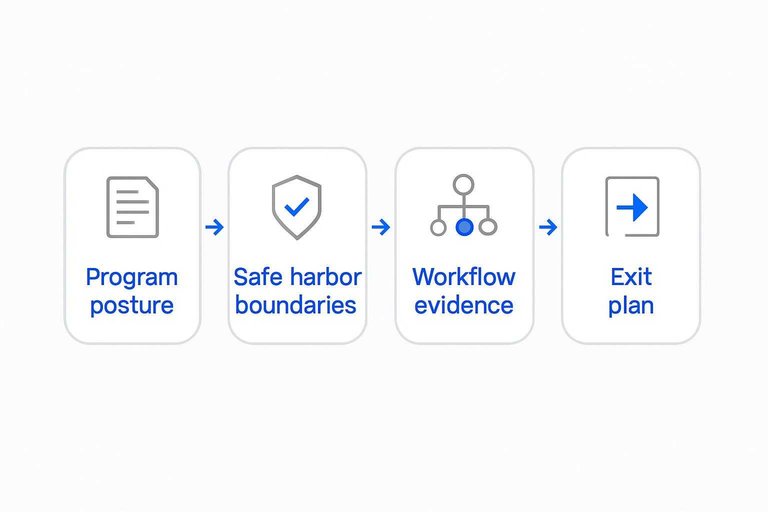
-
Program posture you can point to
Request the exact public artifacts you’ll rely on: a program page, in-scope/out-of-scope targets, rules of engagement, disclosure timeline expectations, and a researcher-facing directory listing (if they run a directory). -
Safe-harbor + authorization boundaries (in writing)
Ask for the vendor’s safe-harbor template and the document that proves you’re authorizing testing on specific assets (who authorizes, what’s allowed, what’s explicitly banned). If you need a baseline, request their mapping to the CISA Vulnerability Disclosure Policy Template. -
Workflow evidence (not screenshots of a marketing UI)
Request a live demo that follows one report from intake → triage → closure, plus an export of the full audit trail (timestamps, status changes, and all messages/attachments). If they sell “AI assistance,” require documentation of what the AI can access and what is retained. If a vendor claims workflow management and exportable reports (PDF/CSV), make them prove it with real data you can move and rehydrate elsewhere. -
Payments + identity controls
If bounties are in scope, demand the payout flow end-to-end: funding model, approval steps, dispute handling, and researcher identity checks (KYC/AML: identity verification / anti–money laundering). For scale plausibility, ask for independently verifiable payout evidence; if they can’t provide any, treat payout/volume claims as unproven. -
Data handling + access controls
Request the DPA (data processing agreement), subprocessor list, retention/deletion policy, and role-based access model with SSO (single sign-on) and audit logging. -
Exit plan (prove you can leave)
Require a migration runbook and sample exports that allow you to recreate cases elsewhere: raw report data, comments, attachments, and identities/payout records (as permitted). If you operate under government directives, confirm the vendor can support your reporting obligations (e.g., Binding Operational Directive 20-01). This is also where a platform like Hacknexa.io (positioned around assessment + reporting + workflow) should be able to demonstrate clean exports and a practical handoff story—if they can’t, treat “tooling” claims as incomplete until proven.
Decision rules
Use this as a decision memo: pick the simplest model that still gives you auditable intake, triage, and a safe-harbor posture you can defend.
| If your situation looks like… | Rational choice (winner) | Decision rule you can paste into a memo |
|---|---|---|
| Always-on public intake, volume control, and a defensible platform story | HackerOne | Choose the vendor that is independently listed as a bug-bounty/VDP platform; expect platform-level throughput controls when restrictions apply (e.g., 6 trial reports across the platform for new researchers, and 8 trial reports per program for seasoned researchers) and build around them. |
| Your real requirement is “publish a channel,” not a platform workflow | Self-hosted VDP channel | If a monitored email + security.txt meets your bar, keep it in-house and own continuity, routing, and recordkeeping. |
| You need a defined window and scope, not an open-ended public inbox | Fixed-scope pentest or managed PTaaS (vendor-run pentest workflow) | Buy time and scope: a time-boxed engagement is easier to staff, easier to budget, and avoids public-submission operations. |
| You want to treat Hacknexa.io as a platform alternative | No-go until proof pack clears | Require reachable first-party docs (the site returned HTTP 502 in this run), third-party catalog corroboration (HackerOne is listed; “hacknexa” is not), and a VDP process mapped to ISO/IEC 29147:2018. |
Choose the model, then the operator
If you need an always-on disclosure or bounty channel you can defend operationally today, pick the option with published safe-harbor posture, auditable workflow, and known throughput controls—and plan around its documented constraints rather than assuming “free” means stable forever. If your real requirement is simply to publish a reliable way to receive reports, own it with a monitored channel plus clear policy language, and keep continuity and recordkeeping in-house. Treat Hacknexa.io as a potential workflow-and-reporting alternative only after it can show reachable first-party documentation and a verifiable intake→triage→closure trail with exports you can take with you; until that proof pack clears, it’s not a like-for-like platform choice. For organizations that want a mature crowdsourced ecosystem with managed triage and platform-level gating already spelled out, HackerOne remains the straightforward fit.
Frequently Asked Questions
- How can I quickly verify whether Hacknexa.io is a real bug bounty/VDP platform like HackerOne?
- Check whether it appears in a vendor-neutral bug bounty/VDP platform catalog and whether it has publicly reachable, first-party documentation for program workflow and terms; for example, the disclose/bug-bounty-platforms list includes HackerOne but not Hacknexa.io.
- What should I do if Hacknexa.io is down (HTTP 502) but I need a vulnerability disclosure program now?
- Publish a basic VDP immediately using a monitored email address and a security.txt file, then migrate to a platform after you can verify the vendor’s documentation and workflow; during this research run, hacknexa.io returned an HTTP 502 so first-party mechanics weren’t verifiable.
- Is a security.txt file enough for a VDP, or do I need a full platform like HackerOne?
- A basic VDP can be satisfied by publishing a clear reporting channel (like security.txt plus a monitored email), but a platform becomes necessary when you need structured intake, triage, and an auditable case history instead of ad-hoc email threads.
- Is it risky to rely on a free VDP tier as my only disclosure channel?
- Yes—free VDP tiers can include unilateral limit changes, reduced functionality, or discontinuation rights in their terms, so you need continuity planning like exports and an alternate reporting route.
- What evidence should I ask for before switching VDP tooling if I have compliance obligations like BOD 20-01?
- Ask for an exportable, end-to-end audit trail (intake → triage → closure), data retention/deletion terms, and a documented exit plan that lets you recreate cases elsewhere so you can still meet obligations such as Binding Operational Directive 20-01.
Operationalize Your Vulnerability Intake
Once you’ve picked the operating model, the next bottleneck is execution: consistent scoping, authorized engagement boundaries, and a triage-to-closure trail your team can keep.
If you’re evaluating an alternate operator for testing and reporting, Hacknexa.io positions as a digital security platform offering penetration testing, vulnerability assessment, and security reporting to help move findings from discovery to remediation.
Sources
- RFC 9116: A File Format to Aid in Security Vulnerability Disclosure — referenced in What you’re choosing
- Essential VDP Additional Terms | HackerOne — referenced in HackerOne, in practice
- Safe Harbor Overview & FAQ | HackerOne Help Center — referenced in Hacknexa.io: what’s verifiable
- Vulnerability Disclosure Policy Template | CISA — referenced in Due-diligence proof pack
- Restricted from Submissions | HackerOne Help Center — referenced in Decision rules
